
- Home
- Saucer-shaped satellites
Saucer-shaped satellitesWhat they are, why the shape works, and how HALO takes it further
Guide
Flying saucers are no longer science fiction. Disc-shaped satellites are flying in orbit today, and OrbitalX is developing HALO, a saucer-shaped satellite platform built for defence missions.
Drag or use arrow keys to rotate
What is a saucer-shaped satellite?
A saucer-shaped satellite is a spacecraft built as a flat or lens-shaped disc rather than a box. The disc gives more surface for power and antennas, stacks tightly for launch, spins stably about its axis and cuts drag when flown edge-on.
You may also see the idea described as a disc-shaped satellite, a disk satellite, a circular satellite bus or, less formally, a flying saucer satellite. They all describe the same design choice: arranging a spacecraft's volume as a wide, shallow body with a single axis of symmetry.
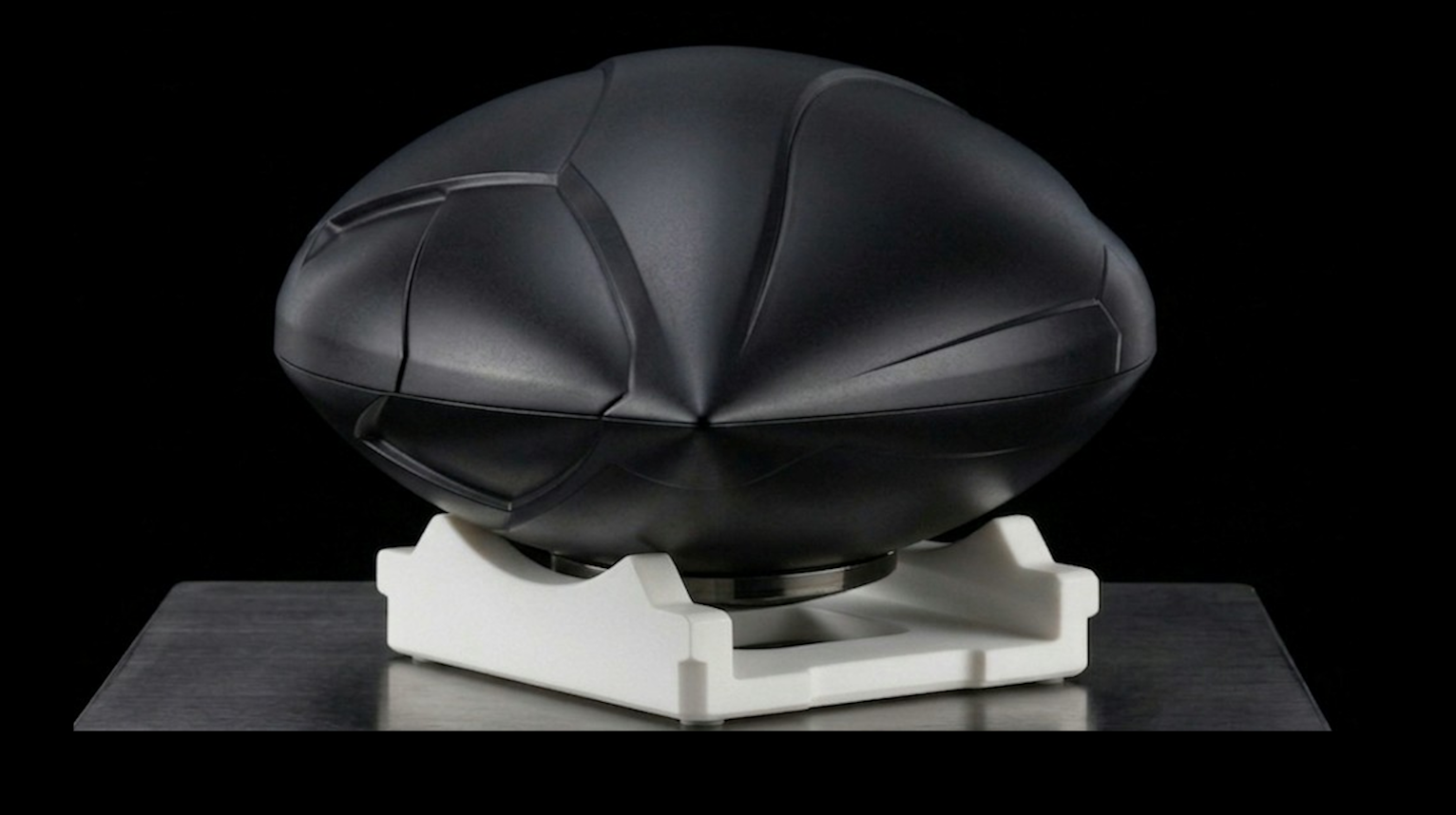
OrbitalX's HALO platform is a saucer-shaped satellite bus designed for defence, surveillance and reconnaissance.
Why the saucer shape works
Four advantages come from geometry alone, before any other technology is added.
More surface
At equal volume, a 3 m by 0.6 m disc has about 2.7 times the upward-facing area of a cube. That area carries solar cells and flat antennas without fragile deployable wings.
Stable spin
A disc's moment of inertia about its central axis is close to twice that about any other axis. Bodies spin stably about their major axis, so the saucer naturally resists tumbling.
Less drag
Flown edge-on, the disc meets the thin upper atmosphere with a small frontal area. Less drag means less propellant to stay in very low orbit.
Efficient launch
Discs nest one on top of another inside a rocket fairing, making good use of volume and simplifying deployment of several spacecraft from one launch.
-
Top view
A broad, continuous upper face for solar cells and flat antennas.
-
Profile
A shallow lens shape: thin at the rim, deeper at the core for payload volume.
-
Stacked
Discs nest together inside a launch fairing.
-
Edge-on
Flown edge-on, the disc slips through the thin upper atmosphere.
-
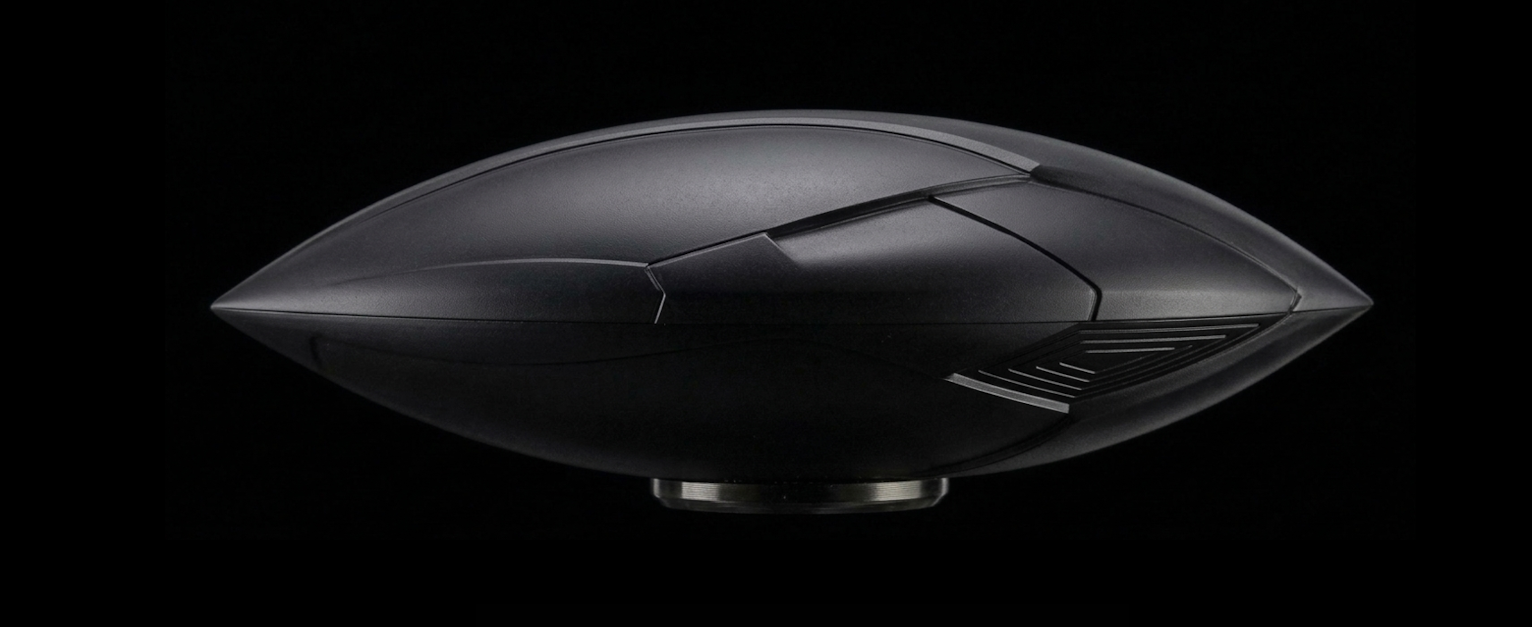
Spin-stable
Twice the inertia about its central axis, so it naturally resists tumbling.
-
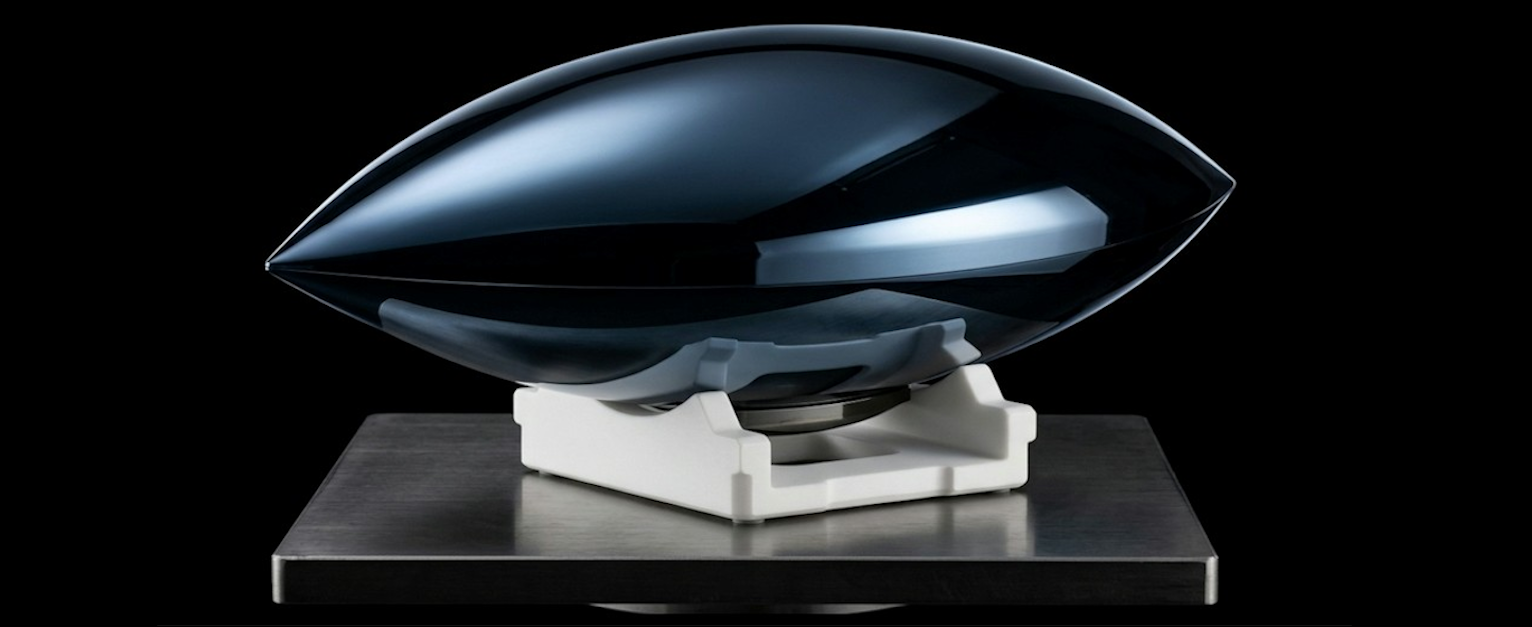
Deployed
Payload bays, thrusters and apertures working together in orbit.
-
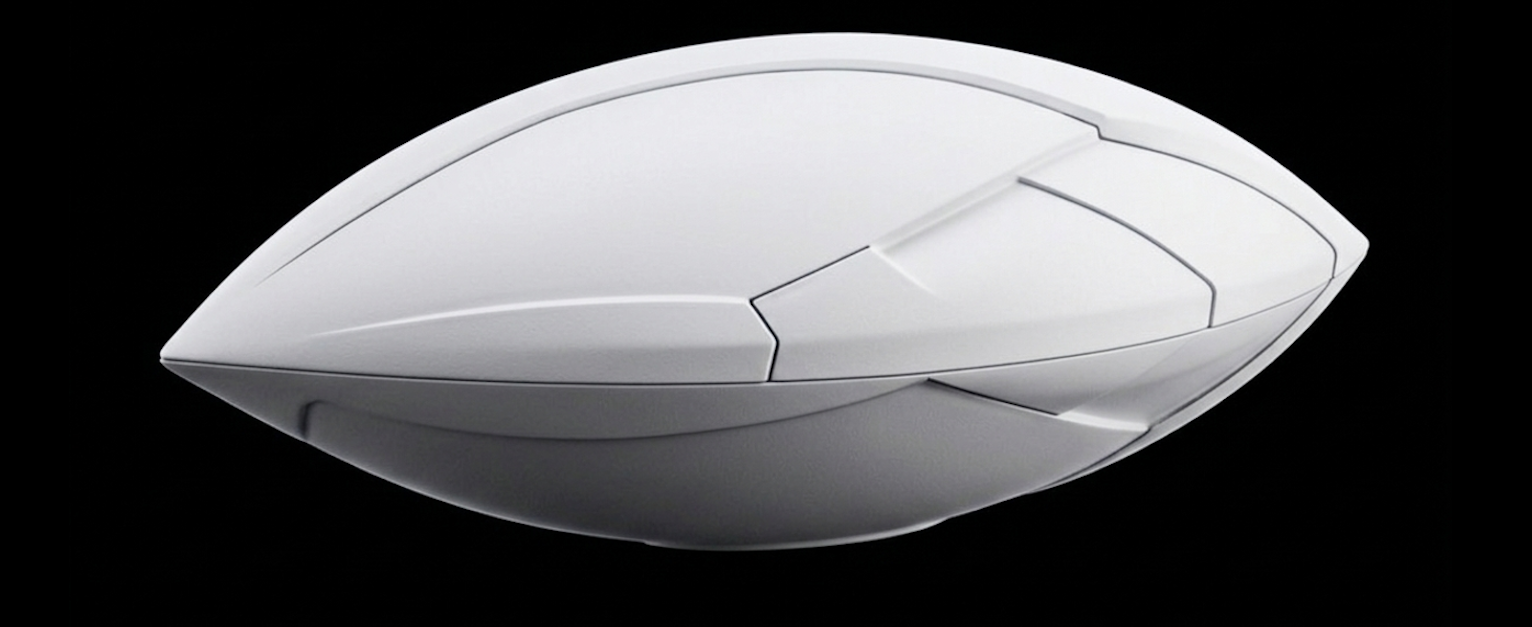
Operational
A defence-grade saucer-shaped satellite platform, built in the UK.
Saucer versus box versus flat panel
How the main satellite form factors compare. A qualitative guide; real performance depends on the full design.
| Property | Box bus | Flat panel | Thin disc | HALO lens disc |
|---|---|---|---|---|
| Sun-facing area per volume | Low; relies on deployable arrays | High | High | High, conformal across the upper face |
| Launch packing | Moderate | Excellent, stacks flat | Excellent, stacks flat | Good, discs nest |
| Passive spin stability | None preferred | About the panel normal | About the disc axis | About the disc axis |
| Internal payload volume | High | Low | Low | Moderate, with a central core and bay ring |
| Drag in very low orbit | Higher | Low edge-on | Low edge-on | Low edge-on |
| Shielding for electronics | Good | Limited | Limited | Good, core surrounded by structure |
Disc-shaped flight, from Avrocar to HALO
Engineers have returned to the disc again and again. Here are some of the real milestones.
Avrocar
Avro Canada's VZ-9 Avrocar, a saucer-shaped aircraft developed for the US military, was flight-tested but never flew far beyond hovering close to the ground. The programme ended in 1961.
Spin-stabilised satellites
Early communications satellites such as Syncom 2 were short cylinders spun about their axis for stability, the same physics a saucer exploits.
NASA's flying saucer
NASA's Low-Density Supersonic Decelerator, a saucer-shaped test vehicle, was lifted by balloon and flown at high speed over the Pacific in 2014 and 2015 to test technology for landing heavy payloads on Mars.
DiskSat reaches orbit
On 18 December 2025, four DiskSats, each about one metre across and 2.5 cm thick, launched on Rocket Lab's Electron from Wallops Island. Built by The Aerospace Corporation with NASA and US Space Force support, they demonstrated power, electric propulsion, attitude control and formation flying.
HALO
OrbitalX is developing HALO in the UK: a larger, lens-shaped saucer platform with a shielded core, modular payload bays, metamaterial surfaces and electric propulsion, designed for defence missions.
What saucer-shaped satellites are used for
- Reconnaissance and Earth observation: a wide aperture and the option to fly lower both improve image resolution.
- Radar and RF sensing: the broad upper face suits large flat-panel antennas and metasurfaces that steer beams electronically.
- Communications relay: high power from a large solar area supports strong, secure links.
- Space domain awareness: monitoring other objects in orbit, helped by a stable, manoeuvrable platform.
- Very low Earth orbit operations: an edge-on profile and electric propulsion make lower, sharper orbits sustainable. Read more in our guide to VLEO.
How HALO builds on the saucer
Thin disc satellites prove the form works for small spacecraft. HALO applies it to a larger, mission-grade bus. Its lens profile adds depth at the centre for a shielded core housing power, avionics and propellant, surrounded by a ring of eight modular payload bays.
The upper face carries a conformal solar array and antenna apertures; the lower face works as a radiator. Electric thrusters sit at the rim, where they have long lever arms for fine control. Printed metal structure and metamaterial surfaces reduce mass and manage how the platform reflects and emits energy.
Explore the HALO platform · See the systems architecture
Sources: NASA, DiskSat; The Aerospace Corporation, DiskSat. Geometric figures are OrbitalX calculations for idealised shapes.
Questions
What is a saucer-shaped satellite?
A saucer-shaped satellite is a spacecraft built as a flat or lens-shaped disc instead of a box. The shape gives a large surface for solar cells and antennas, stacks efficiently inside a rocket, is naturally stable when spinning about its central axis, and presents a small cross-section to the atmosphere when flown edge-on.
Are there real saucer-shaped satellites?
Yes. In December 2025 four DiskSat spacecraft, flat discs about one metre across and 2.5 centimetres thick designed by The Aerospace Corporation with NASA and US Space Force support, launched on a Rocket Lab Electron. OrbitalX is developing HALO, a larger saucer-shaped platform for defence missions.
Why are most satellites box-shaped?
Boxes are simple to design, build and test. Flat panels are easy to mount equipment on, deployable solar arrays fold neatly against flat faces, and decades of heritage and standards such as the CubeSat are built around rectangular structures.
What are saucer-shaped satellites used for?
Typical missions include Earth observation and reconnaissance, radar and RF sensing, communications relay, space domain awareness and technology demonstration. The large aperture and ability to fly in very low orbit make the shape well suited to high-resolution sensing.
Can a saucer-shaped satellite fly in very low Earth orbit?
The shape helps. Flown edge-on, a disc presents a small frontal area, reducing atmospheric drag. Combined with efficient electric propulsion to make up the remaining drag, that makes sustained flight in very low Earth orbit more practical.
Is a saucer-shaped satellite a UFO?
No. It is an ordinary, identified spacecraft that happens to be disc-shaped for sound engineering reasons. It is tracked, registered and operated like any other satellite.
How is HALO different from DiskSat?
DiskSat is a thin, flat small-satellite platform of about 13.5 kg. HALO is a larger, lens-shaped disc with internal volume for a shielded central core and a ring of modular payload bays, designed for defence surveillance and reconnaissance and integrating metamaterial surfaces and printed structure.
Who is building saucer-shaped satellites in the UK?
OrbitalX, based at Oxford Science Park, is developing HALO, a saucer-shaped satellite platform for UK defence and allied government customers.
Explore HALO's technology
- Saucer-shaped satellitesWhat disc-shaped spacecraft are, why the shape works, and where HALO fits.
- HALO vehicleThe saucer-shaped bus: geometry, structure, subsystems and payload bays.
- Ion propulsionElectric thrusters for station-keeping, drag make-up and repositioning.
- MetamaterialsEngineered structures that steer beams, manage heat and carry load.
- Additive manufacturePrinted metal structures, topology-optimised for the loads they carry.
- Systems architectureHow power, control, data and payloads fit together on one platform.
Interested in a saucer-shaped platform?
Talk to OrbitalX about partnership, procurement or research collaboration on HALO.